News

News

Updates from USC IMPACT LAB, including publications, project milestones, student achievements, opportunities, and lab announcements.

Screenshot of the Machine Learning for Engineering Applications companion portal homepage.

ML4EA book companion portal launched

The companion portal for Prof. Yan Jin's book Machine Learning for Engineering Applications is now live. The portal connects the book's mathematical foundations, modern machine learning methods, and engineering judgment through practical examples and supporting resources. It provides multiple entry points for students, readers, verified instructors, and the broader engineering community, including chapter guidance, learning resources, an Application Examples catalog, teaching support, errata, updates, and ways to contribute new examples and resources. The portal is intended to serve as a living extension of the book, helping readers move from concepts to executable engineering applications.

Square SmartSOM NSF award graphic showing agent-based self-organizing manufacturing concepts.

SmartSOM NSF project funded

USC IMPACT LAB is pleased to announce that the collaborative NSF project Next-Generation Self-Organizing Manufacturing Systems Integration for Personalized and Dynamic Production has been funded, with a planned start date of September 1, 2026. Led by Prof. Yan Jin at USC in collaboration with Prof. Bingling Huang at CSU Fullerton, the project advances the scientific foundations of self-organizing manufacturing systems that coordinate production through distributed decision-making rather than centralized control. The research will integrate task constraints, observational social learning, and organizational learning within a multi-agent reinforcement learning framework to support dynamic scheduling, resource allocation, and process control under volatile production conditions. The project aims to contribute to more resilient and responsive manufacturing enterprises while supporting graduate and undergraduate student training, educational materials, simulation tools, and broad dissemination of research findings in intelligent manufacturing.

BRIDGE project researchers from Japan and USC IMPACT LAB members meeting at USC.

BRIDGE project researchers visit USC IMPACT LAB

USC IMPACT LAB was pleased to host BRIDGE project researchers from Japan on July 13-14, 2026, including Professors Ichinose and Sakai from the University of Osaka, Dr. Kakuta and Ms. Goto from MTI Co., Ltd. During the two-day visit, the guests presented the overall vision of the large BRIDGE project, sponsored by the Japan National Maritime Research Institute, as well as the practical details of the case studies that IMPACT LAB team members are pursuing through the AIDIO project. The IMPACT AIDIO team also presented recent progress on the AIDIO project and demonstrated the latest agentic AI system release, AIDIO-CS1. The meetings led to fruitful technical discussions and helped build a shared understanding of multiple approaches toward achieving the goals of both BRIDGE and AIDIO. The teams also explored how human-AI systems can provide the next generation of support for engineering practice in the shipbuilding industry and beyond.

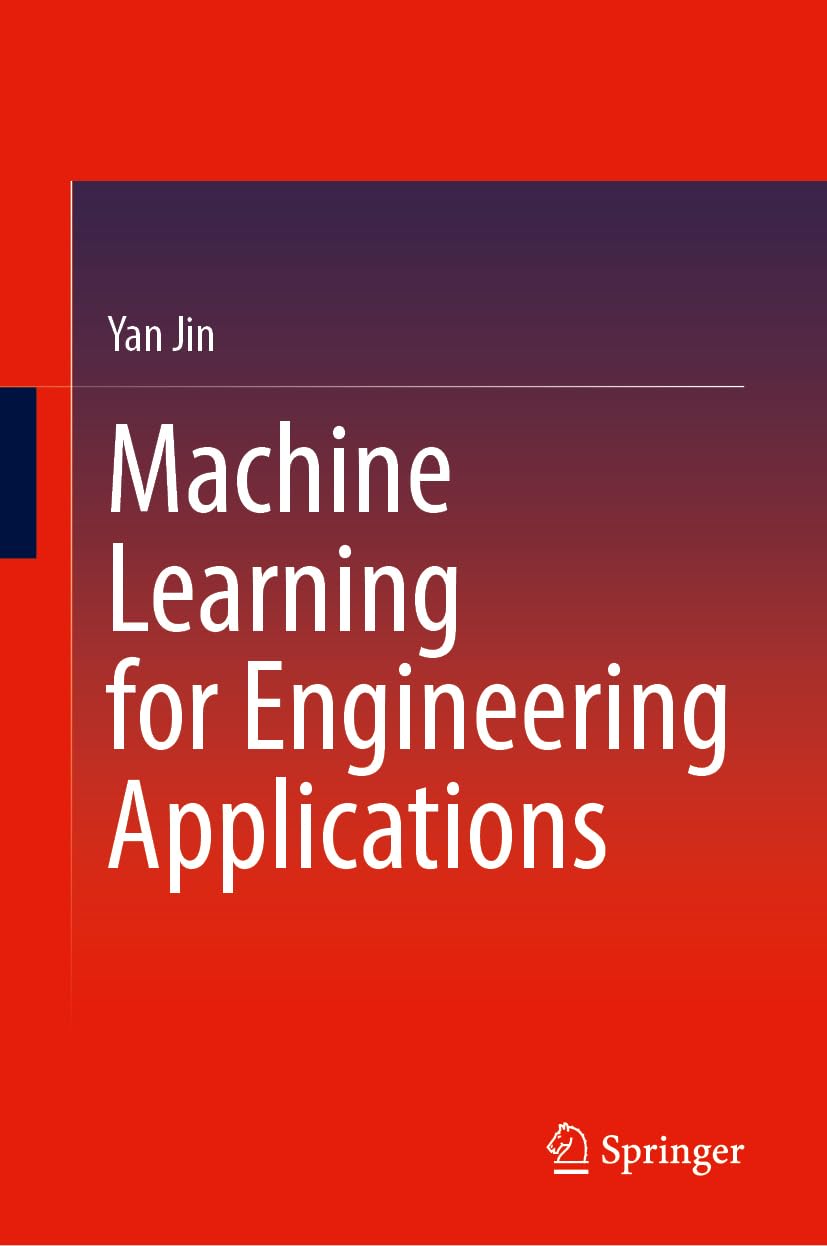
Cover of Machine Learning for Engineering Applications by Yan Jin.

New Springer book available for pre-order

Prof. Yan Jin's new book, Machine Learning for Engineering Applications, is now available for pre-order from Springer. Written for engineers and engineering students, the book introduces the mathematical foundations and core concepts of machine learning in an accessible, engineering-centered way, with methods connected throughout to engineering scenarios and real-world datasets. The book addresses a growing need for resources that teach machine learning from the perspective of engineering applications, including smart manufacturing, sensor-rich infrastructure, predictive maintenance, autonomous systems, and intelligent product design. In addition to theoretical derivations, the book emphasizes hands-on Python implementation and covers emerging topics such as physics-informed neural networks and agentic architectures for engineering problems. The hardcover edition is scheduled for publication by Springer on August 12, 2026.

IMPACT LAB research visual used for the new website announcement.

USC IMPACT LAB launches new GitHub-hosted website

USC IMPACT LAB is pleased to launch its new website. Our previous lab site went offline about two months ago after a computer crash and eventual hardware damage. The new site is hosted through GitHub, which makes the lab website easier to maintain, version, update, and recover without relying on a single local machine. The site now provides a more stable home for our research themes, projects, people, publications, sponsors, collaborators, and news. We will continue updating the content over time and welcome feedback from lab members, alumni, collaborators, sponsors, and visitors. Please let us know if you notice missing information, have suggestions for improvement, or would like to contribute content.

BRIDGE-AIDIO kick-off meeting graphic with IMPACT Lab, MTI, and OCEANS logos.

BRIDGE-AIDIO project kick-off meeting held

The BRIDGE-AIDIO project team held its kick-off meeting on May 12 (13 in Japan), 2026, bringing together, among many participants, Drs. Ando and Kakuta from MTI, Profs. Ichinose and Sakai from OCEANS at the University of Osaka, and Prof. Yan Jin from USC IMPACT LAB. Prof. Jin presented the research activities completed during the past month and summarized the current status of the AIDIO project. The meeting then moved into a productive discussion on collaboration logistics between USC and the teams in Japan, including coordination mechanisms, information sharing, and near-term development priorities. The next step for the project is to develop and test the first prototype AIDIO system, establishing an initial foundation for AI-integrated ship design, inspection, and optimization research.

IDETC/CIE 2026 conference graphic.

Three IMPACT LAB papers accepted to IDETC/CIE 2026

We are pleased to share that three papers from USC IMPACT LAB have been accepted to the ASME 2026 International Design Engineering Technical Conferences & Computers and Information in Engineering Conference (IDETC/CIE 2026), to be held August 23-26, 2026 in Houston, Texas. The accepted papers reflect the lab's growing research portfolio in agentic AI for engineering systems, self-organizing manufacturing, and domain knowledge acquisition for AI-assisted systems engineering. The papers are: "SEMAA: An Agentic AI Approach to Systems Modeling" by Ardalan Aryashad and Yan Jin; "A Phase-I Benchmark of Self-Organizing Manufacturing Control Under Heterogenity and Volatility" by Jian Ni, Shih-Chun Deng, and Yan Jin; and "Domain Knowledge Acquisition in AI-Assisted Systems Engineering" by Sara Sourani, Shih-Chun Deng, and Yan Jin. Congratulations to Ardalan, Jian, Shih-Chun, Sara, and Prof. Jin on this exciting milestone.

News graphic for the JCISE paper on enhanced deep reinforcement learning for motion planning.

Chuanhui Hu and Yan Jin paper published online in JCISE

We are pleased to announce that the paper "An Enhanced Deep Reinforcement Learning Approach to Motion Planning With Knowledge Transfer and Online Demonstrations" by former IMPACT LAB member Dr. Chuanhui Hu and Prof. Yan Jin has been published online in the ASME Journal of Computing and Information Science in Engineering. The work advances deep reinforcement learning for long-range motion planning by combining high-level planning policies, knowledge transfer, and online demonstrations from global planning algorithms. This approach improves training efficiency and navigation performance while addressing key challenges such as sparse rewards, long-horizon decision-making, and adaptation in complex environments. Congratulations to Dr. Hu on this important publication and continued contribution to intelligent motion planning research.

Graphic for a DOE Genesis Mission proposal on agentic digital twins for additive manufacturing and fusion energy systems.

Collaborative DOE Genesis Mission proposal submitted

USC IMPACT LAB joined collaborators from the University of Utah, Oak Ridge National Laboratory, and Arizona State University in submitting a proposal to the Department of Energy's Genesis Mission program. The proposal, "Agentic Digital Twin for Closed-Loop Design and Monitoring of Additively Manufactured Fusion Energy Reactors," responds to the Genesis challenge area on reenvisioning advanced manufacturing and industrial productivity. The proposed work aims to connect additive manufacturing, in-service nondestructive evaluation, uncertainty-aware digital twins, and agentic AI decision support for fusion-relevant reactor components operating in extreme environments. IMPACT LAB's contribution focuses on agentic AI workflows and human-in-the-loop engineering decision support, helping bridge sensing evidence, digital twin reasoning, compliance checking, and adaptive redesign. The submission reflects the lab's growing commitment to AI-enabled engineering systems that can accelerate science, strengthen advanced manufacturing, and support future energy technologies.

Shih-Chun Morris Deng.

Shih-Chun (Morris) Deng admitted to USC AME Ph.D. program

USC IMPACT LAB warmly congratulates Shih-Chun (Morris) Deng on his admission to the USC Department of Aerospace and Mechanical Engineering Ph.D. program, with enrollment beginning in the Fall 2026 semester. Morris graduated from National Taiwan University. He joined the lab in September 2025 after taking Prof. Yan Jin's AME 505 Machine Learning for Engineering Applications course. Since then, he has actively participated in and contributed to several ongoing IMPACT LAB projects, bringing curiosity, technical energy, and steady commitment to the team's research activities. We are delighted to welcome Morris as he formally joins the lab as a Ph.D. student, and we wish him great success as he begins this next stage of his research journey.

BRIDGE-AIDIO proposal graphic showing AI-integrated ship design, inspection, optimization, and robotic shipbuilding.

AIDIO proposal submitted to NMRI BRIDGE program

USC IMPACT LAB joined MTI Co., Ltd. and submitted the proposal "AIDIO: AI-integrated Design, Inspection and Optimization" to Japan's National Maritime Research Institute (NMRI) on February 17, 2026. The proposal is part of the BRIDGE program, which aims to bridge research and development with Society 5.0 and generate economic and social value. AIDIO seeks to realize AI-integrated engineering in the shipbuilding domain by connecting the full pathway from customer needs, to basic design, to robotic shipbuilding. The proposed work envisions an intelligent digital thread in which AI agents support design generation, rule-grounded inspection, optimization, and production-ready data preparation. By linking early requirements with downstream robotic construction, AIDIO aims to help future shipyards use AI not only as a design assistant, but as a coordinated engineering capability for more productive, traceable, and automation-ready shipbuilding.

SmartSOM NSF proposal graphic showing self-organizing manufacturing concepts.

SmartSOM proposal submitted to NSF with CSU Fullerton collaborator

USC IMPACT LAB submitted an NSF proposal on SmartSOM in collaboration with Prof. Bingling Huang at California State University, Fullerton. The proposed research investigates the theoretical and technical foundations for a self-organizing, multiagent manufacturing integration framework designed for highly volatile personalized production environments. The project plan builds on task-constraint modeling, social learning, and organizational learning to help manufacturing agents coordinate dynamic scheduling, resource allocation, and process control without relying on rigid centralized control. The research will study how task constraints can generalize to heterogeneous manufacturing domains, how peer observation can accelerate learning and improve team performance, how organizational norms can emerge among agent teams, and how robustness, adaptability, quality, and efficiency can be measured and balanced. Through simulation and experiment-in-the-loop validation, SmartSOM aims to advance intelligent, resilient, and human-centered manufacturing systems for future personalized markets.

IMPACT LAB research visual for IDETC/CIE 2025 conference presentations.

IMPACT LAB presents robotics papers at IDETC/CIE 2025

USC IMPACT LAB presented two papers at the ASME 2025 International Design Engineering Technical Conferences & Computers and Information in Engineering Conference (IDETC/CIE 2025), held August 17-20, 2025 in Anaheim, California. Ardalan Aryashad presented "VLAG: Graph-Based Planning for Vision-Language-Action Models in Long Horizon Manipulation Tasks," which introduces a modular graph-based planning framework for vision-language- action robotic manipulation. Prof. Yan Jin also presented "Knowledge Capture, Adaptation and Composition (KCAC): A Framework for Cross-Task Curriculum Learning in Robotic Manipulation" on behalf of Dr. Xinrui (Serena) Wang, a former IMPACT LAB Ph.D. student. Together, the two papers highlight the lab's growing research direction in robotic intelligence, reinforcement learning, curriculum learning, and modular planning methods for long-horizon manipulation tasks.

IMPACT LAB research visual for the ASME Design Theory and Methodology Award announcement.

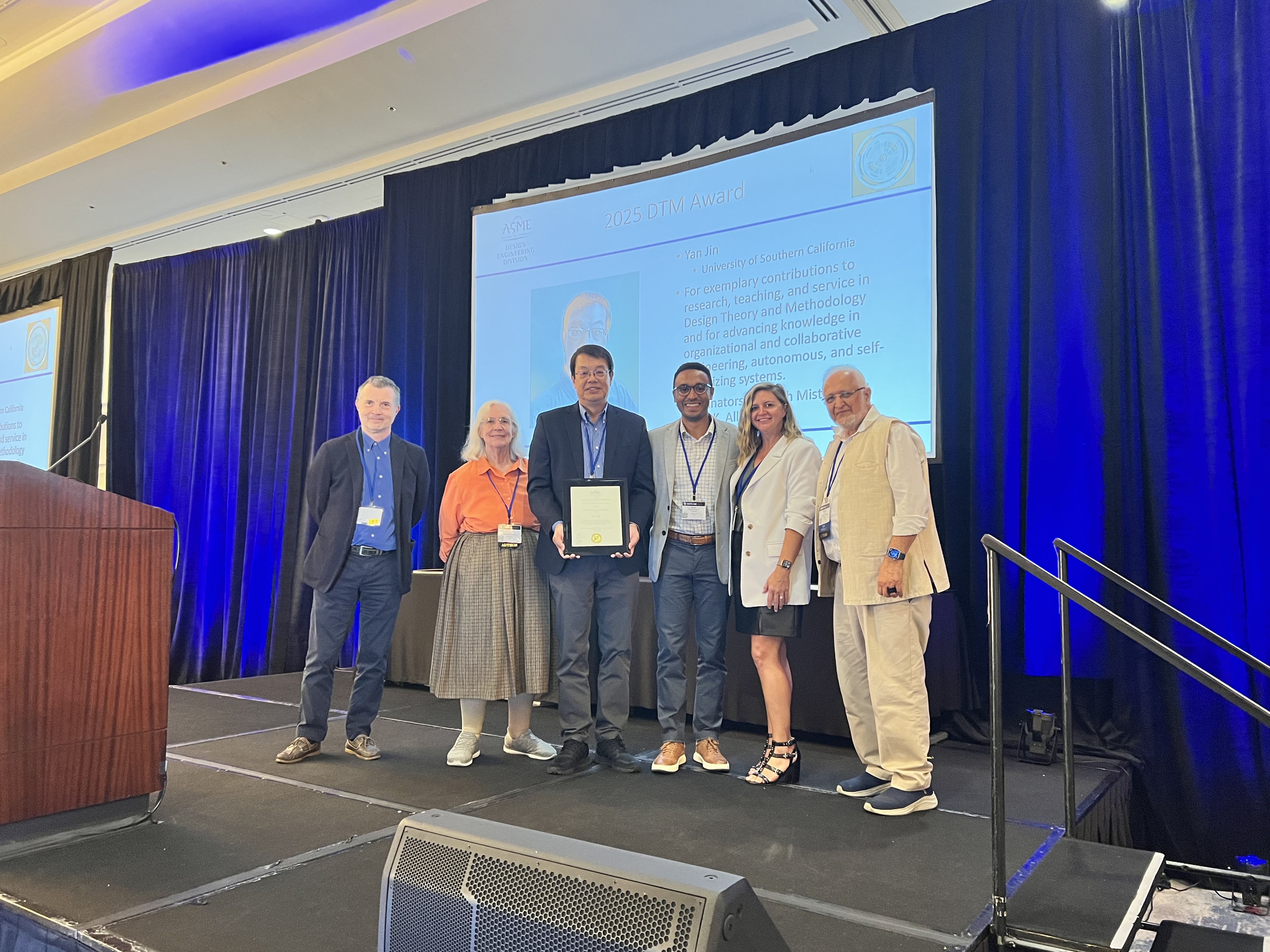
Yan Jin receives the ASME Design Theory and Methodology Award

USC IMPACT LAB is proud to celebrate Prof. Yan Jin's receipt of the ASME Design Theory and Methodology Award. Established by ASME's Design Engineering Division, the award recognizes sustained and meritorious contributions to research, education, service, training of researchers or practitioners, leadership, or a combination of these contributions in the field of Design Theory and Methodology. Prof. Jin's citation reads: "For exemplary contributions to research, teaching, and service in Design Theory and Methodology and for advancing knowledge in organizational and collaborative engineering, autonomous, and self-organizing systems." This recognition reflects a long-standing body of work that has shaped IMPACT LAB's research foundations in AI-integrated and human-centered engineering design, organizational modeling, autonomous systems, and self-organizing intelligent engineering systems.